Showing posts with label Urdu Poets and Urdu Poetry. Show all posts
Showing posts with label Urdu Poets and Urdu Poetry. Show all posts
Tuesday, February 8, 2011
 |
| Urdu Poetry |
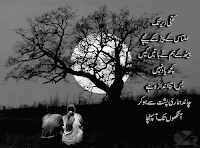
Described below are the most fundamental ones with respect to “Ghazal”, the most popular form of Urdu poetry. Ghazal is composed of distinct couplets, called “ashaar” indigenously. Now, each “ghazal” takes into account either all, or some of the factors given below.
- Bahar: defines the meter or length of the couplet, with the restriction for each line of the couplet to have same “bahar”. There are 19 types of “bahar” categorized into short, medium or long ones.
- Radeef: represent a word or phrase that is repeated at the end of second line of each couplet. It should be same throughout the poem.
Save And Share :


|
| Urdu Poetry |
Urdu is amongst top five of the most commonly spoken languages all across the globe with the number still on the rise every passing day due to the rich cultural and historical background it boasts to have over a period of some 900 years through the pages of history.
If you also happen to be one of the active readers of Urdu poetry, then it would be of great help to you to have a couple of excellent resources of Urdu poetry to please your aesthetic demands, all the same quenching your thirst of meaningful knowledge.
If you are living in a place, country, or city where reading material in this language is available, then your local library could be a convenient and helpful resource to grant access to some very good books of poetry to let you expose to the new knowledge and joys of the language.
Save And Share :
Sunday, November 21, 2010
The poetry of any language is judged by various factors. The variety is the spice of the poetry of any language. Different factors, which are used to weigh the poetry of any language, are the topic diversity, forms, and terminology. The same is the case with the poetry in Urdu language.
The following is a brief overview of the topics, forms, and terminologies used in the Urdu poetry.

- Topic diversity of Urdu poetry
The topics of the Urdu poetry have varied with time. For example, the initial Urdu poetry was aimed to promote harmony between the people who spoke various languages. Gradually as the Urdu language developed, the poetry became romantic. However, most of the poems were about one-sided love and the stubbornness of the beloved. With passing time, the romance from the Urdu poetry waned a little. The new topics were current affairs, political situation, and the issues of social importance.
Save And Share :
“Poetry is ordinary language raised to the Nth power. Poetry is boned with ideas, nerved and blooded with emotions, all held together by the delicate, tough skin of words”.
Paul Engle
Paul Engle
 It is a fact that the poetry can greatly influence the society. The Urdu poetry is a perfect example of this statement. There are four dimensions, which are the most significant examples of the influence of the Urdu poetry on the society. These are briefly explained below.
Save And Share :
Friday, November 12, 2010
 Muslim Welfare Society organized an Urdu play on Mirza Assad-ullah Khan Ghalib titled Mirza Galib Ki Haveli, at Balgandharva Rangmandir, Pune India, on November 10th, 2010.
Pune City First Sikh Mayor Mohansingh Rajpal was invited for viewing the play. Mayor Mohansingh Rajpal said “Urdu plays should be staged reqularly in the city. THis will help in exchange of culture of Hindi, Marathi and Urdu theatre industry,”
Save And Share :
Wednesday, November 10, 2010
There is a common perception in Urdu language native speaker that Urdu is losing its fame, elegance and acceptability. Urdu language is fading as number of Urdu litterateurs deteriorating, but Urdu Poet, pen name Shaharyar proved this perception wrong by wining Jnanpith Award.
 |
| Urdu Poet Shaharyar |
Shaharyar is known for his lyrics in Film Daman “'Seene Mein Jalan Aankhon mein Toofan Sa kyon Hai”. He was felicitated Urdu Department of Lucknow University on Tuesday November 9th,2010. He is alsi known for his remarkable ghazal of the Film Umrao Jan, “In ankhon ki masti key diwaney hazaron hai.”
Save And Share :
|
| Urdu Poet Shaharyar |
Save And Share :
Monday, November 8, 2010
Dr. Wazir Agha is the name of a great man who was born in the British India of 1922. He was an Urdu critic, a prose writer, a poet and a philosopher. The Urdu language is alive and thriving due to great people like Dr. Wazir Agha.
 Dr. Wazir Agha wrote an excellent biography of his life, which is a great read. When he was born his business man father got a janam patri for him to trace the journey of his life. however the man of principles, Dr. Wazir Agha never even opened that janam patri, not even to take a glance.
Urdu was not the only speciality of Dr. Wazir Agha. He was a great linguist who also knew Persian, English and Punjabi. He used to speak Urdu, English, Persian and Punjabi equally fluently. Dr. Wazir Agha’s father used to speak in Persian to his children, as Persian was considered the most respected language of the Muslims of the subcontinent. So this was the way he learned to speak Persian. His father used to speak Punjabi to his mother, who was of Punjabi ancestry. So, that was the way Dr. Wazir Agha learned Punjabi.
Save And Share :
Wednesday, November 3, 2010
Mirza Asad Ullah khan Beg Ghalib is a great contributor to the Urdu literature. He was a poet of the 18th century. He was a trendsetter in the Urdu poetry.

Ghalib’s personal life had always been disturbed. He was married at a very young age. He never had a reliable source of income. He was a habitual alcoholic. His wife used to suffer due to his lack of attention. Mirza Ghalib have had children but most of them died at a very young age. Therefore, he was not a happy man. This combination proved to be excellent for some masterpieces of Urdu poetry.
Save And Share :
Thursday, October 21, 2010

The Urdu poetry is one of the richest poetry in the idea and expression all over the world. What have made it so popular are the different dimensions that it has kept throughout the history.
Just like the poetry of the most of other languages, Urdu poetry is enriched by the romantic verses. So many poets contributed to the romantic Urdu poetry. Mir Taqi Mir and Zauq are distinguished names from the past.
Save And Share :
Sunday, October 17, 2010
Many great names contributed to make Urdu diction and expression meaningful and beautiful in the form of poetry. This write-up aims to highlight the famous Urdu poets of different centuries.
13th century
The poetry of Urdu language dates back to 13th century. The most prominent poet of Urdu language of 13th century was Amir Khusro. With his sweet meaningful verses, he became the pioneer of Urdu poetry.
Save And Share :
Thursday, October 7, 2010
 Dr. Vazir Agha (May 18, 1922- September 7, 2010) writer, poet critic and essayist lived in Sargodah. Daily magazine named "Auraq" was run by him from decades. He introduce many different concepts in Urdu Literature, The most famous was Urdu Humor. He also wrote different book on modern Urdu poets, specifically on those who has written more nazms than ghazals. His poetry always contains some element of story.
Save And Share :
Monday, October 4, 2010
Marsia is sad poem written especially for the martyrdom Hussain and his comrades of Karbala. Marsia is typically on the Death of Hussain and Hassan and their families. Sometimes Marsia is also written on the Death of some relatives or friend. Marsia is consists for different stanzas each stanza has six lines typically. Usually the Marsia is heavily read by the people in the first ten days of Muharram.
Save And Share :
Friday, October 1, 2010
Qasida is also known as chakameh in Persian Language. It is actually a form of Poetry of Pre - Islamic Arabia. Typically Qasida goes up to 50 to 100 lines. It was then later adopted by Persian and there length of Qasida extended to more than 100 lines and this extended version of Qasida was highly appreciated by natives of Persia.
Save And Share :
Masnavi was first introduced by Jalal al-Din Muhammad Rumi, A renowned Persian Sufi saint and poet. In Sufism and Persian literature, Masnavi is the most influential work. Masnavi is series of 6 books of poetry having round about 25,000 verses or 50,000 lines. The purpose of writing Masnavi is to guide believers, that how can we refine soul spiritually and can maintain strong connection with GOD.
Save And Share :
Wednesday, September 29, 2010
Allama Iqbal was a great poet and Philosopher and Politician in British India. Sir Muhammad Iqbal is commonly known as Allama Iqbal meaning of Scholar (Allama). He conveyed his Philosophy in Persian and Urdu.
Save And Share :
Tuesday, September 28, 2010
Subscribe to:
Posts (Atom)


